
Cement Industry Fans are essential for airflow control, ventilation, exhaust, dust collection, cooling, combustion, and process gas handling throughout modern cement production plants.
EMS manufactures and supplies industrial centrifugal fans for raw material grinding, preheating, precalcining, cement kilns, clinker cooling, cement grinding, dust collection, and flue gas treatment.
Cement production involves high temperatures, abrasive dust, high system resistance, and continuous operation. Fan construction can therefore be engineered with wear-resistant materials, high-temperature components, reinforced structures, and heavy-duty drive systems according to the actual operating conditions.
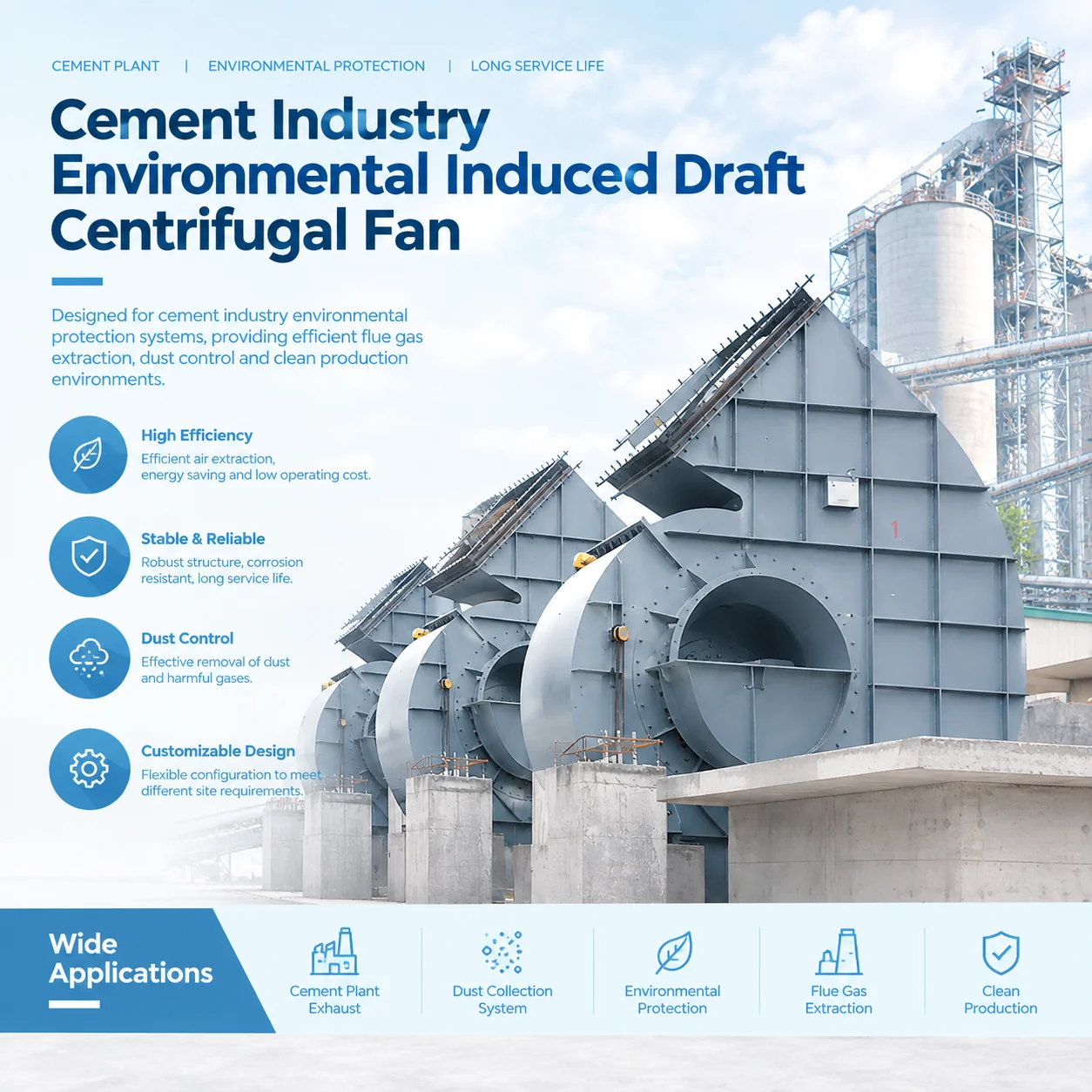
Cement Kiln ID Fans extract hot flue gases from the cement kiln system and convey them toward downstream dust collection and environmental treatment equipment while maintaining the required process airflow conditions.
Used for ventilation and gas circulation in cement grinding systems, providing stable airflow through the grinding and separation process.
Raw Mill Fans provide process airflow for raw material grinding systems and handle dust-laden gases generated during raw mill operation.
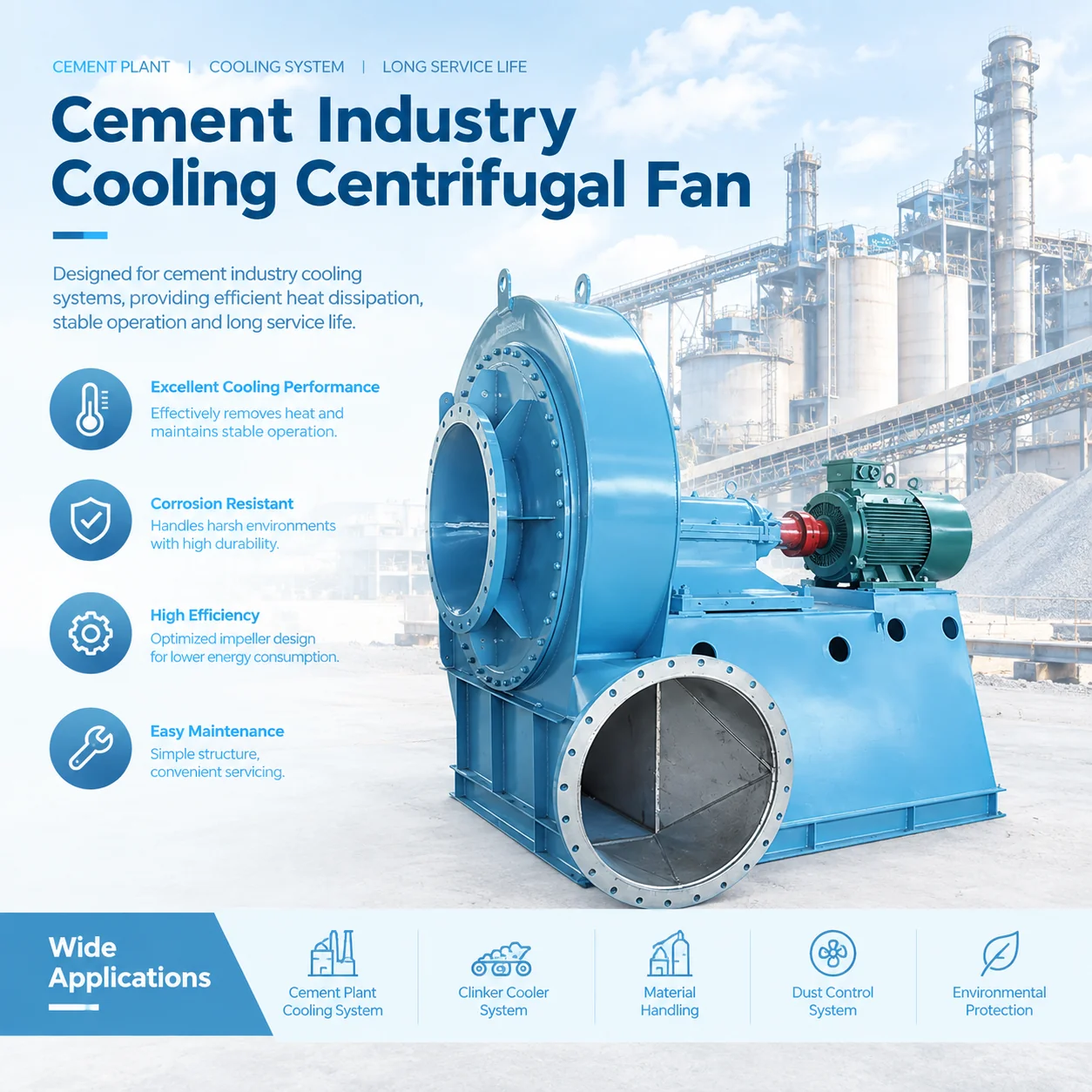
Used to supply cooling air to clinker coolers, supporting efficient clinker cooling and heat recovery.
Used to extract dust from material handling, grinding, conveying, storage, and other cement production processes. These fans can be integrated with bag filters, electrostatic precipitators, and other dust collection systems.
Used for process gas handling and airflow control in preheater systems where elevated-temperature gases are present.
Provide combustion and process air to kilns, burners, and other cement production equipment requiring controlled air supply.
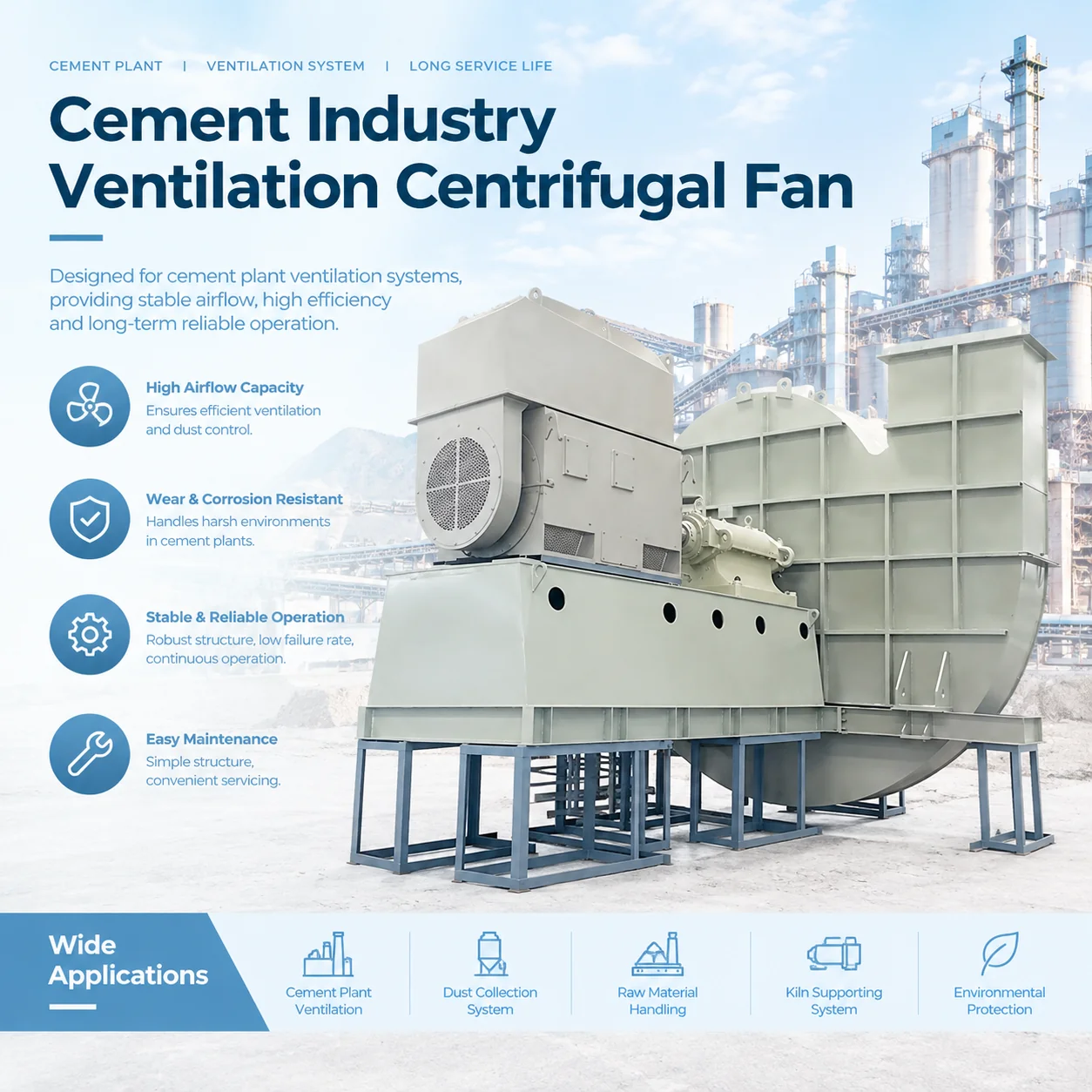
Used for process gas circulation, conveying, exhaust, and ventilation throughout cement production systems.
Used for industrial exhaust and ventilation in production areas, process equipment, and environmental treatment systems.
Designed for demanding cement applications involving high dust loads, abrasive particles, high system resistance, and continuous-duty operation.
Raw Material Crushing
Raw Material Grinding
Raw Mill Ventilation
Preheating
Precalcining
Cement Kiln
Clinker Production
Clinker Cooling
Cement Grinding
Cement Storage
Dust Collection
Flue Gas Treatment
Material Conveying
Plant Ventilation
| Parameter | Typical Range |
|---|---|
| Air Volume | 2,000–500,000 m³/h |
| Total Pressure | 1,000–20,000 Pa |
| Static Pressure | 800–18,000 Pa |
| Operating Temperature | -20°C to 500°C+ |
| Motor Power | 2.2–1,000 kW |
| Fan Speed | 500–2,900 rpm |
| Fan Efficiency | Up to 85%+ |
| Impeller Diameter | Approx. 400–3,000 mm |
| Drive Type | Direct / Coupling / Belt |
| Material | Carbon Steel / Stainless Steel / Wear-Resistant Steel |
| Installation | Horizontal / Vertical / Customized |
These are typical engineering ranges for reference. Final specifications depend on airflow, pressure, gas temperature, dust concentration, particle characteristics, system resistance, and installation conditions.
Cement production generates abrasive dust from raw materials, clinker, and cement particles. For high-dust applications, wear-resistant steel, protective liners, reinforced impellers, and other abrasion-resistant components can be selected.
Cement kiln and preheater systems involve elevated-temperature gases. Depending on actual gas temperature, the fan can incorporate high-temperature materials, shaft cooling, bearing insulation, and thermal expansion compensation.
Raw mills, grinding systems, dust collection equipment, and complex process ductwork can create significant system resistance. Fan pressure and impeller design can therefore be selected according to the required operating point.
Cement plants typically operate for extended periods. Fan shafts, bearings, impellers, casings, and drive systems can be designed for continuous industrial operation.
Large cement production lines can use reinforced casings, heavy-duty bearing housings, high-strength impellers, and coupling-driven configurations.
Cement Plants
Cement Kiln Systems
Raw Mill Systems
Cement Mill Systems
Clinker Cooler Systems
Preheater Systems
Precalciner Systems
Cement Dust Collection Systems
Cement Grinding Plants
Cement Storage Systems
Cement Production Lines
Flue Gas Treatment Systems
EMS can engineer cement plant fans according to:
Airflow
Static / Total Pressure
Gas Temperature
Dust Concentration
Particle Characteristics
Gas Composition
System Resistance
Continuous Operating Time
Installation Space
Motor Power
Power Supply
Inlet / Outlet Direction
Rotation Direction
Fan Material
Available solutions include high-temperature fans, wear-resistant fans, high-pressure fans, dust extraction fans, heavy-duty fans, and customized process fans.
Explore the main EMS product configurations supplied for this industry.