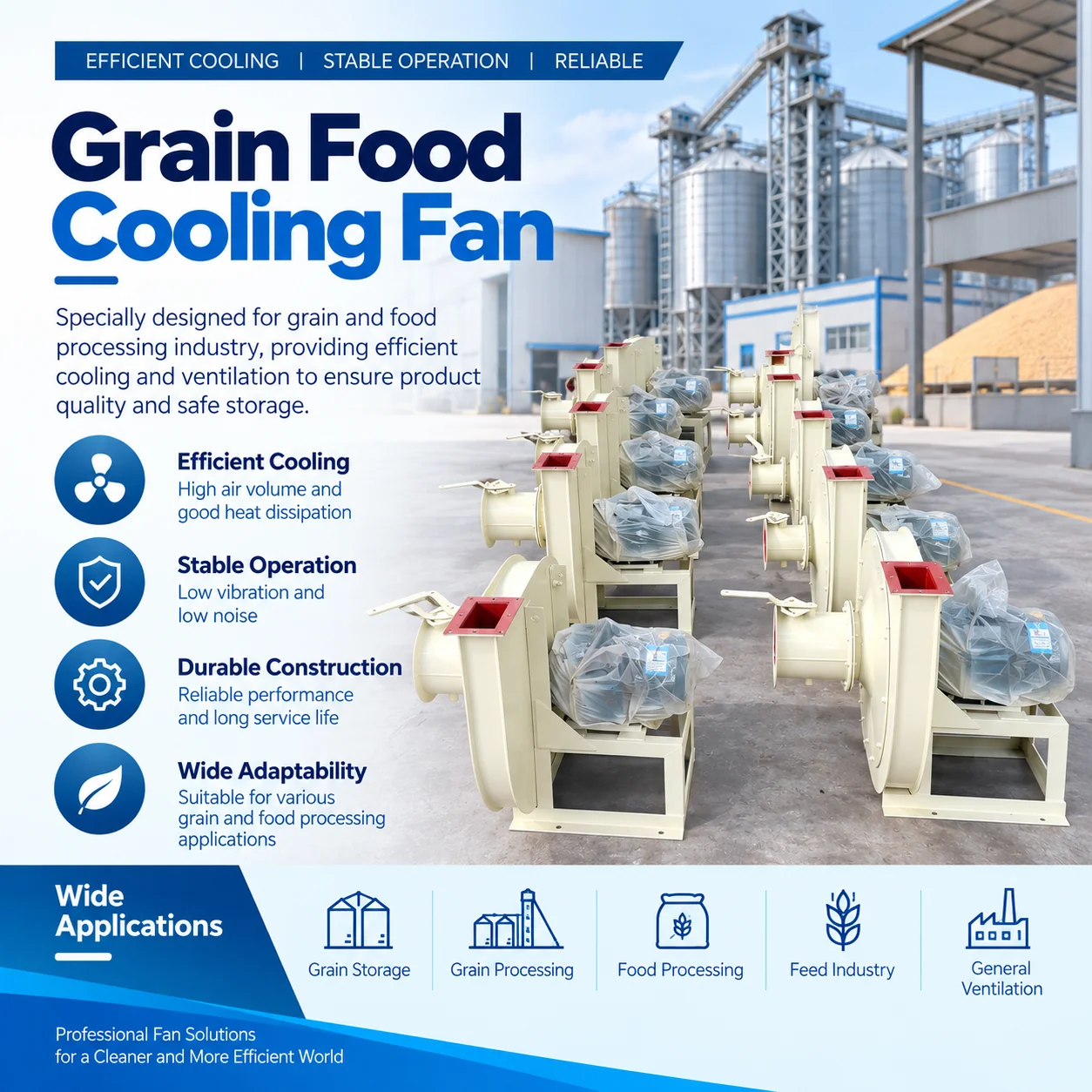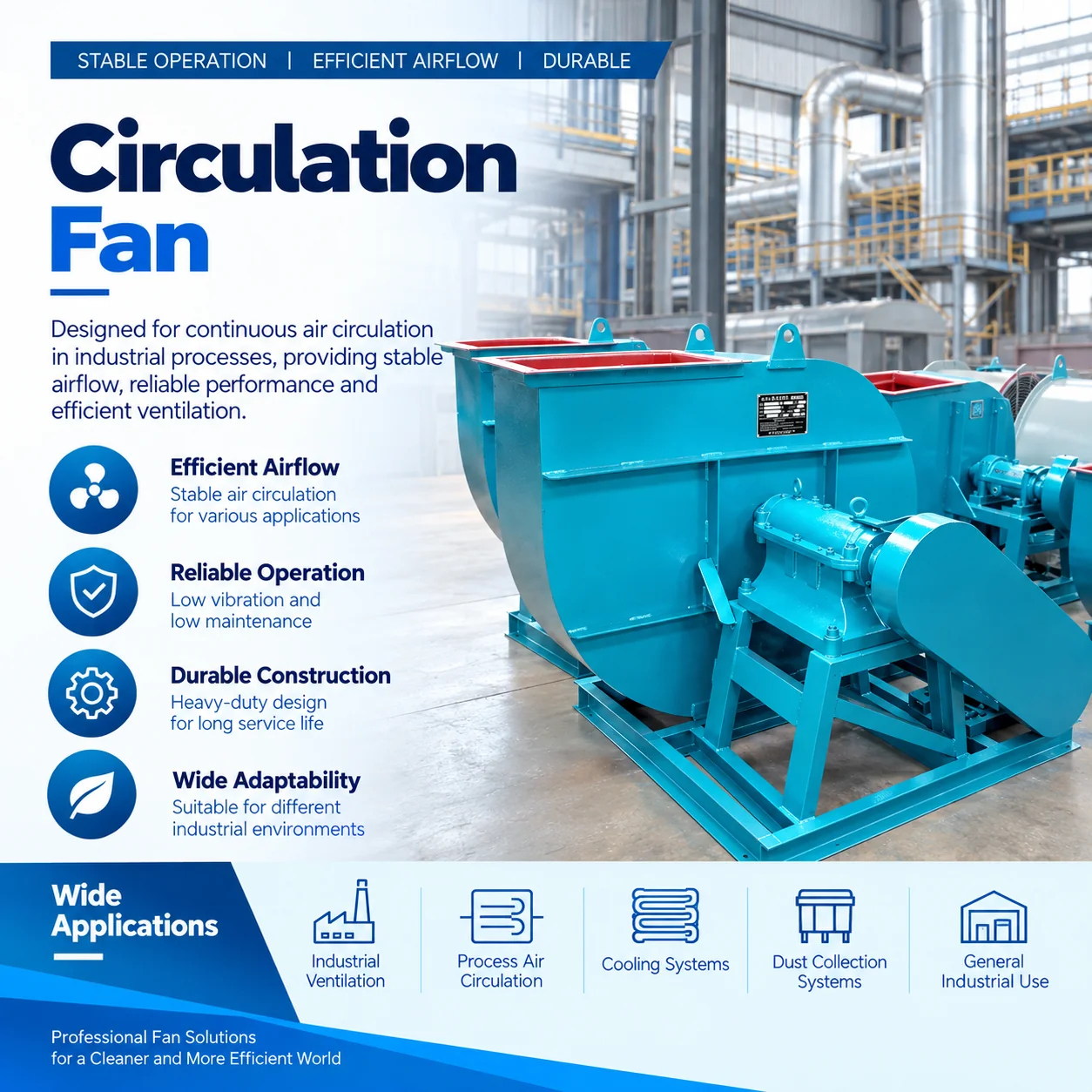

Grain & Food Processing Industry Centrifugal Fans are industrial air handling solutions designed for grain processing plants, food manufacturing facilities, agricultural product processing, and related production systems.
They are widely used for grain drying, grain cooling, pneumatic conveying, dust extraction, dust collection, workshop ventilation, food drying, hot air circulation, process exhaust, and equipment cooling.
Grain and food processing operations often involve particulate materials, moisture, heat, and process air. Fan performance therefore needs to be matched to airflow, pressure, temperature, material characteristics, dust concentration, and system resistance.
EMS provides a complete range of centrifugal fan solutions, including Grain Drying Fans, Grain Cooling Fans, Grain Conveying Fans, Grain Dust Extraction Fans, Food Processing Dust Collection Fans, Food Processing Exhaust Fans, Food Drying Fans, Hot Air Circulation Fans, and customized industrial centrifugal fans.
Used to supply hot air or circulating air for grain dryers, cereal drying systems, seed drying equipment, and industrial agricultural drying processes.
Used to provide cooling airflow for grain and cereals after drying or during storage preparation.
Used for pneumatic conveying of lightweight granular materials and processing by-products in grain handling systems.
Grain cleaning, screening, crushing, milling, and conveying processes can generate dust. Centrifugal fans provide the airflow required for local extraction and centralized dust collection.
Used for dust extraction in flour, starch, cereal, powder, and other food ingredient processing applications.
Used for workshop ventilation, heat removal, local exhaust, air exchange, and process ventilation in food manufacturing facilities.
Used in food drying, baking, dehydration, and other industrial processes requiring stable hot air circulation.
Used to provide cooling and ventilation air for food processing machinery, drying equipment, conveying systems, and other production equipment.
| Product | Application |
|---|---|
| Grain Drying Fan | Grain and cereal drying |
| Grain Cooling Fan | Grain cooling |
| Grain Conveying Fan | Pneumatic grain conveying |
| Grain Dust Extraction Fan | Grain dust extraction |
| Grain Dust Collection Fan | Centralized grain dust collection |
| Food Processing Dust Collection Fan | Food processing dust extraction |
| Food Processing Exhaust Fan | Process and workshop exhaust |
| Food Processing Ventilation Fan | Industrial ventilation |
| Hot Air Circulation Fan | Hot air circulation |
| Industrial Drying Fan | Industrial drying systems |
| Food Processing Cooling Fan | Product and equipment cooling |
| Heavy Duty Grain Processing Fan | Continuous industrial operation |
| Customized Food Processing Fan | Special process applications |
| Technical Parameter | Typical Range |
|---|---|
| Air Volume | 1,000–300,000 m³/h |
| Total Pressure | 500–8,000 Pa |
| Static Pressure | 300–6,000 Pa |
| Gas Temperature | -20°C to 300°C |
| Motor Power | 1.1–500 kW |
| Fan Speed | 500–2,900 rpm |
| Impeller Diameter | 200–3,000 mm |
| Drive Type | Direct / Coupling / Belt Drive |
| Material | Carbon Steel / Stainless Steel / Customized |
| Installation | Horizontal / Vertical / Customized |
| Application | Drying / Cooling / Conveying / Dust Collection / Ventilation |
Actual specifications should be selected according to grain type, material characteristics, airflow, pressure, temperature, dust concentration, moisture, system resistance, and installation requirements.
The fan can provide stable airflow and pressure for grain drying, cooling, ventilation, conveying, and dust extraction systems.
Fan configurations can be selected for wheat, rice, corn, cereals, seeds, beans, and other agricultural products.
Airflow and pressure can be matched to industrial drying and cooling equipment to achieve the required process air circulation.
The fans can be integrated with baghouse filters, cyclone separators, cartridge collectors, and other dust collection equipment.
Carbon steel, stainless steel, and customized materials can be selected according to temperature, humidity, dust concentration, and operating environment.
Airflow, pressure, temperature, materials, speed, motor specifications, inlet and outlet configuration, and installation arrangement can be customized.
Grain & Food Processing Industry Centrifugal Fans can be used in:
Grain processing plants
Cereal processing facilities
Flour mills
Rice mills
Corn processing plants
Feed processing plants
Starch processing plants
Seed processing facilities
Food processing factories
Bakery production lines
Dehydrated food production
Agricultural product processing
Grain drying centers
Grain handling and storage facilities
Provides hot or circulating air for grain dryers and industrial drying equipment.
Provides cooling airflow after grain drying and before storage or further processing.
Provides airflow for pneumatic conveying of grain-related materials and lightweight processing residues.
Extracts dust generated during grain cleaning, screening, crushing, milling, and conveying.
Provides workshop ventilation, heat removal, local exhaust, and process air handling.
Used for food dehydration, drying, baking, and hot air circulation systems.
For proper fan selection, customers should provide:
Required airflow
Required pressure
Grain or food material type
Gas temperature
Moisture level
Dust concentration
Conveying distance
System resistance
Inlet and outlet dimensions
Motor voltage
Frequency
Operating hours
Installation conditions
For drying, cooling, and pneumatic conveying applications, airflow and pressure should be matched to the complete process system rather than selected independently.
Before installation, inspect the foundation, ductwork, impeller, motor, bearings, and drive components.
Before startup, ensure that the impeller is free of foreign objects and verify the correct motor rotation direction.
During operation, monitor motor current, vibration, bearing temperature, and operating noise.
For high-dust grain processing systems, regularly inspect the impeller for dust accumulation and maintain the connected dust collection equipment.
For food processing environments, material selection, surface treatment, cleaning requirements, and hygiene requirements should be considered according to the specific production process.
Where combustible dust may be present, such as in flour, starch, or certain grain processing applications, the complete system should be evaluated for fire, explosion, grounding, and other applicable safety requirements.
Explore the main EMS product configurations supplied for this industry.