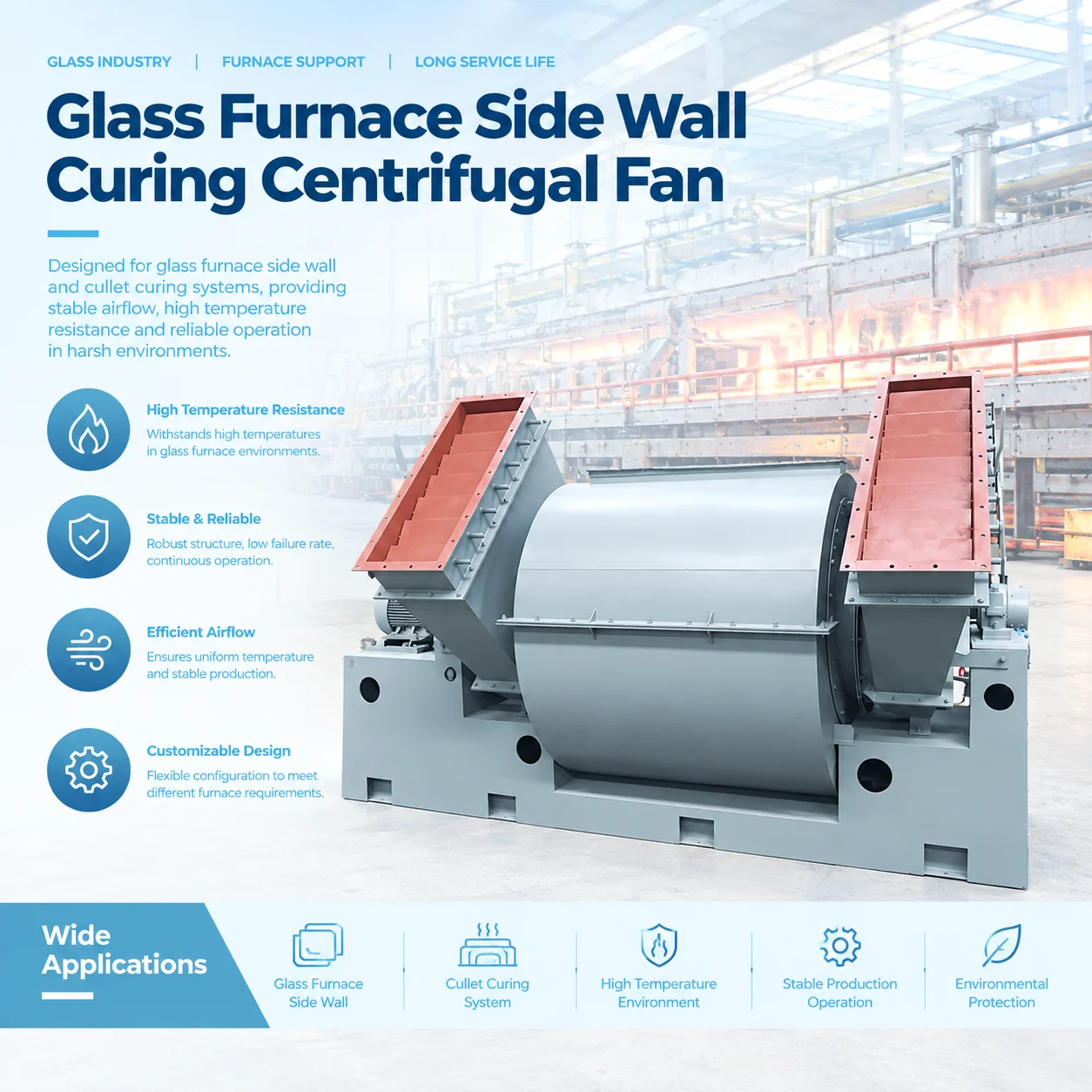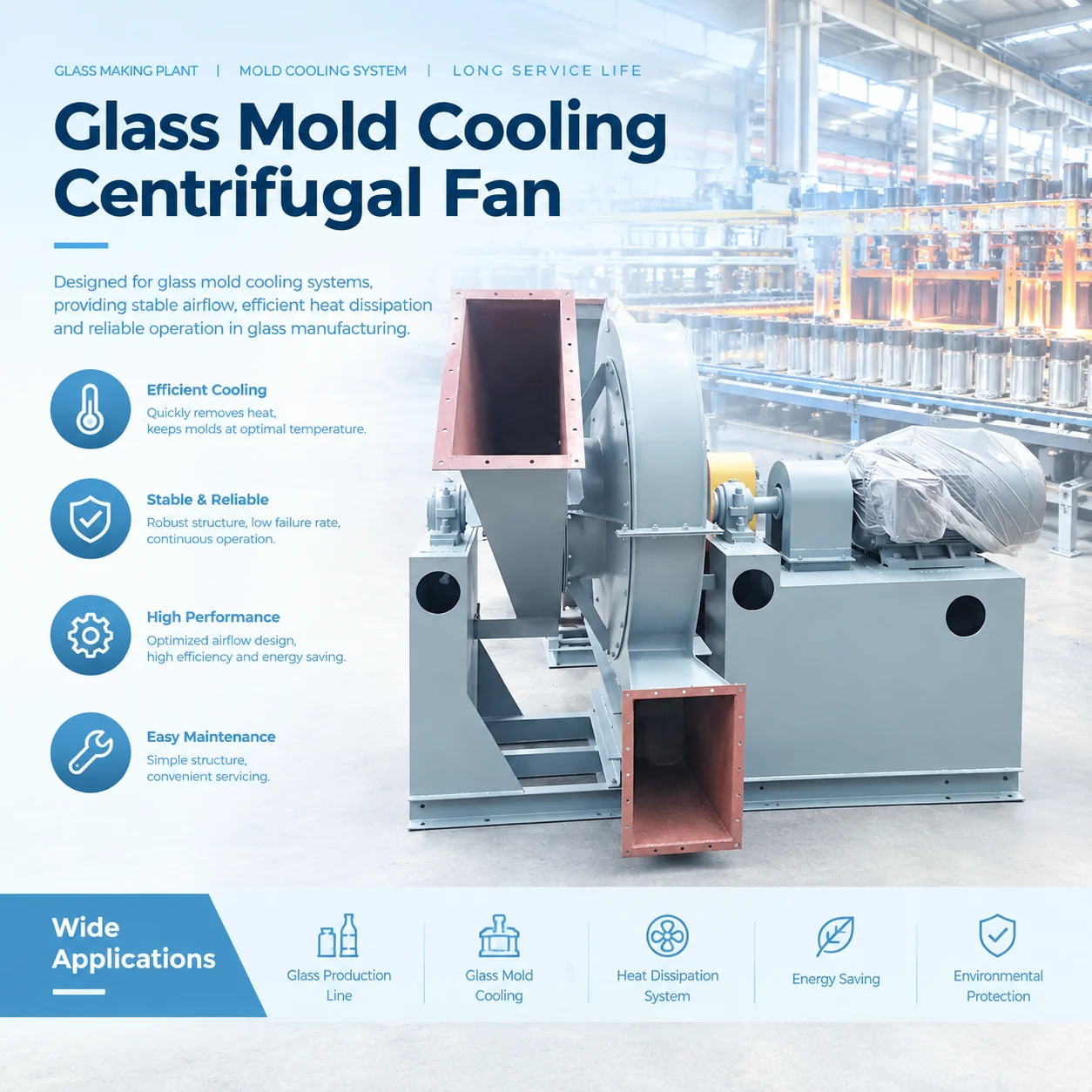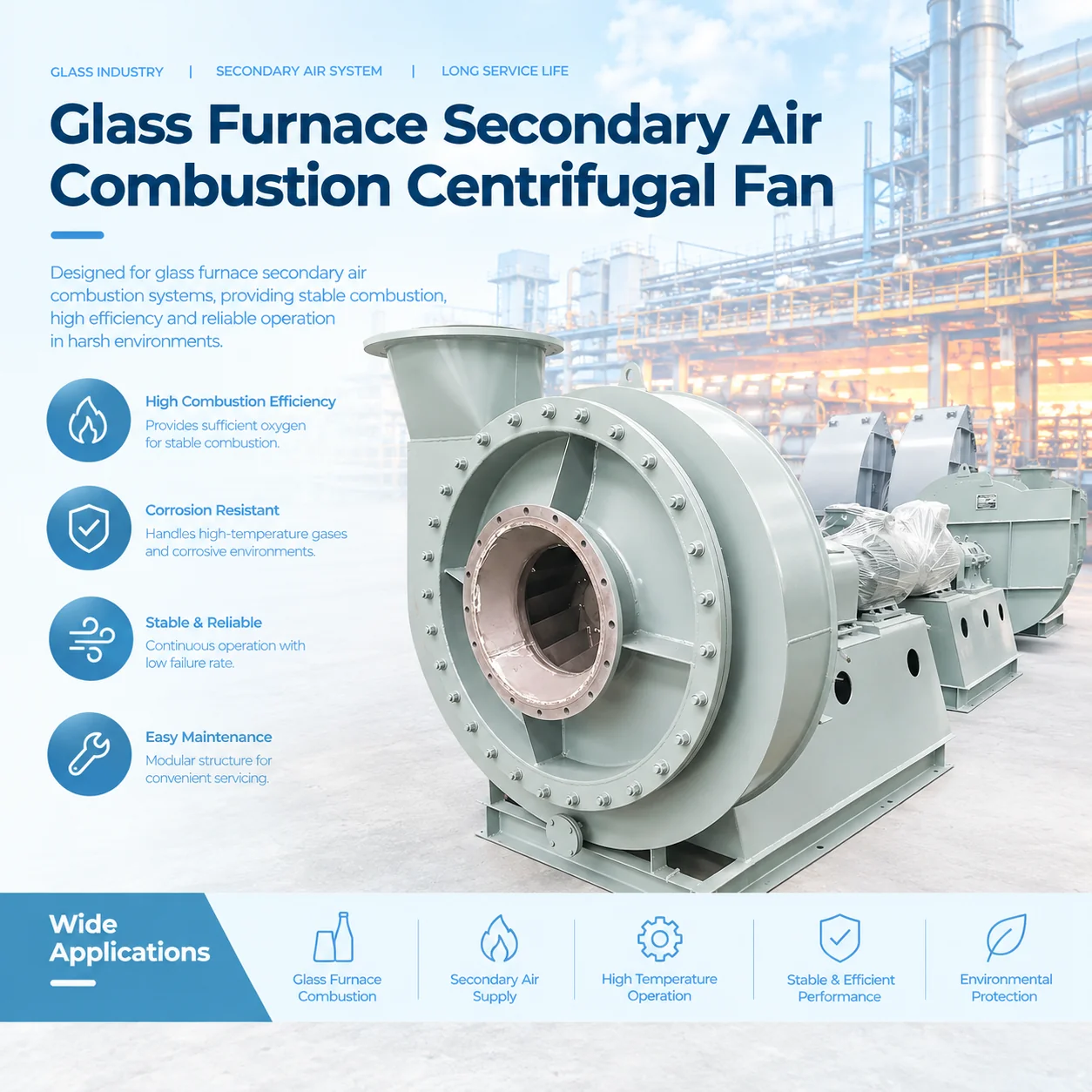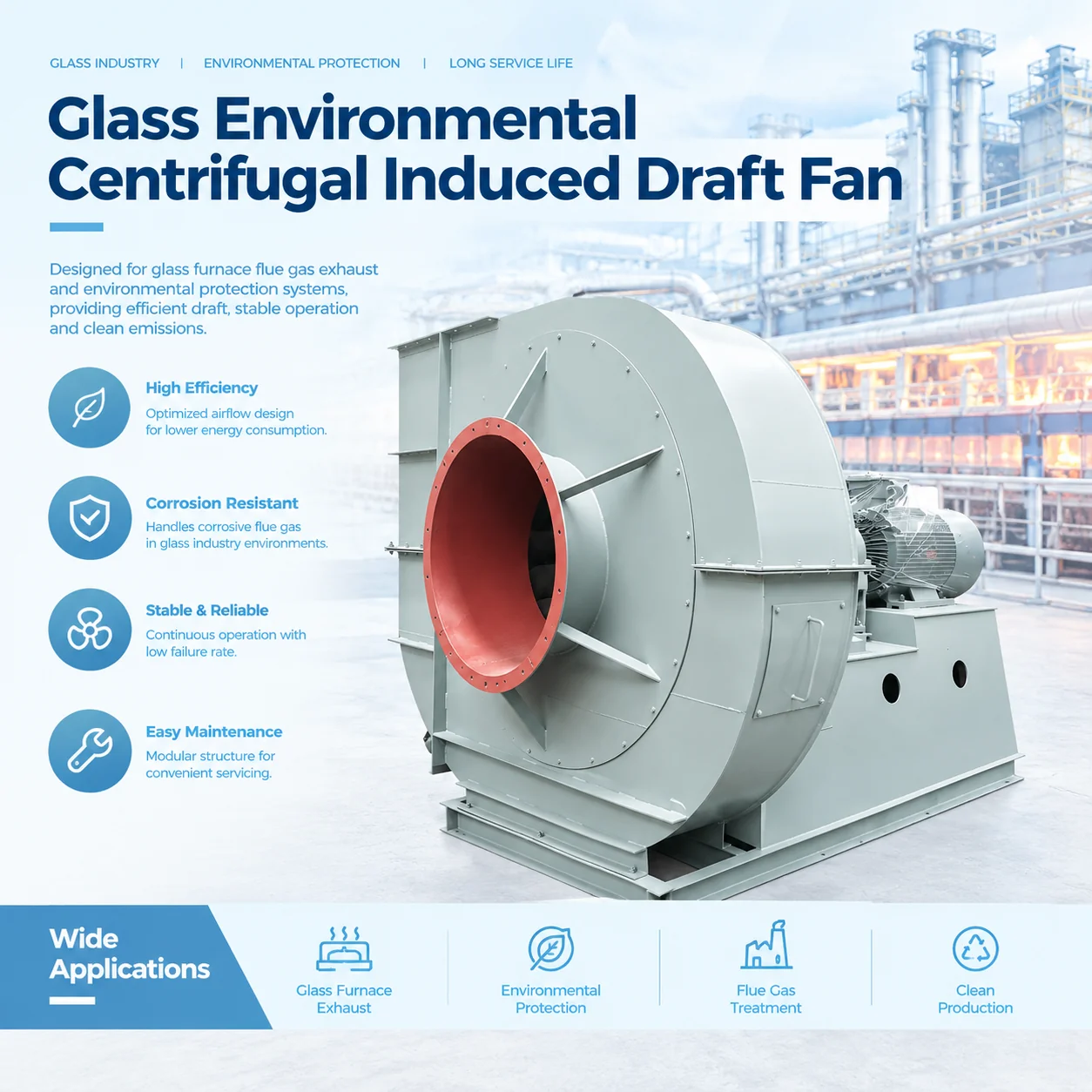

Glass Industry Centrifugal Fans are industrial air handling solutions designed for demanding applications throughout glass manufacturing plants. They are widely used for glass furnace exhaust, combustion air supply, mold cooling, IS machine cooling, furnace ventilation, dust collection, process exhaust, and environmental control systems.
Glass manufacturing involves high-temperature gases, combustion air, furnace exhaust, cooling air, dust, and process gases. These applications require reliable fans with stable airflow, pressure performance, temperature resistance, mechanical strength, and continuous operating capability.
EMS provides a complete range of centrifugal fan solutions for glass manufacturing, including Glass Furnace ID Fans, Glass Furnace FD Fans, Glass Mold Cooling Fans, IS Machine Cooling Fans, Glass Furnace Environmental Fans, Dust Collection Fans, High Temperature Centrifugal Fans, Heavy Duty Industrial Fans, and customized centrifugal fans.
Fan construction, materials, impeller design, bearings, drive systems, and cooling arrangements can be customized according to airflow, pressure, gas temperature, gas composition, dust concentration, and installation requirements.
Glass Furnace ID Fans are used to extract high-temperature flue gas from glass furnaces and maintain the required furnace draft. They can be integrated with downstream environmental and flue gas treatment systems.
Glass Furnace FD Fans supply combustion-supporting air to burners and furnace combustion systems, helping provide stable airflow for the glass melting process.
Glass Mold Cooling Fans provide cooling air to molds and forming equipment. They are commonly used in glass bottle, container glass, and other glass forming production lines.
IS Machine Cooling Fans provide cooling and ventilation air for Individual Section Machines and surrounding production equipment in container glass manufacturing.
Cooling fans can supply air to furnace surroundings, tank-side areas, equipment surfaces, and other high-temperature working areas.
Industrial centrifugal fans are used for general ventilation, local exhaust, heat removal, and air circulation in glass manufacturing plants.
Fans can be used to transport furnace flue gas, hot air, process exhaust, and other industrial gases to downstream treatment or discharge systems.
Glass manufacturing processes can generate dust and particulate matter. Centrifugal fans can be integrated with baghouse filters, cyclone collectors, and other dust collection equipment.
| Product | Typical Application |
|---|---|
| Glass Furnace ID Fan | Furnace exhaust and draft control |
| Glass Furnace FD Fan | Combustion-supporting air |
| Glass Furnace Exhaust Fan | Flue gas and process exhaust |
| Glass Mold Cooling Fan | Mold and forming equipment cooling |
| IS Machine Cooling Fan | IS machine cooling and ventilation |
| Glass Furnace Environmental Fan | Environmental exhaust and ventilation |
| Glass Industry Dust Collection Fan | Dust extraction and collection |
| High Temperature Centrifugal Fan | High-temperature air and gas handling |
| Heavy Duty Centrifugal Fan | Continuous and demanding industrial applications |
| Customized Glass Industry Fan | Special process and installation requirements |
| Technical Parameter | Typical Range |
|---|---|
| Air Volume | 1,000–500,000 m³/h |
| Total Pressure | 500–15,000 Pa |
| Static Pressure | 300–12,000 Pa |
| Gas Temperature | -20°C to 500°C+ |
| Motor Power | 1.1–1000 kW |
| Fan Speed | 500–2,900 rpm |
| Impeller Diameter | 200–3,500 mm |
| Drive Type | Direct / Coupling / Belt Drive |
| Material | Carbon Steel / Stainless Steel / Customized |
| Installation | Horizontal / Vertical / Customized |
| Rotation | CW / CCW |
| Application | Furnace / Cooling / Exhaust / Dust Collection / Ventilation |
The above ranges are typical engineering configurations. Final specifications should be selected according to the actual process requirements, airflow, pressure, gas temperature, gas composition, dust concentration, and installation conditions.
The fan can be manufactured with robust impellers, casings, shafts, bearings, and drive systems for demanding industrial operating conditions.
For glass furnace and hot gas applications, the fan can be configured with suitable materials, shaft cooling, bearing arrangements, and structural solutions according to the actual operating temperature.
Fan performance is matched to the specific process requirements to provide reliable airflow for furnace exhaust, combustion air, equipment cooling, ventilation, and environmental systems.
Carbon steel, stainless steel, and customized materials can be selected according to gas temperature, corrosiveness, dust concentration, and other operating conditions.
EMS can customize the fan according to required airflow, pressure, temperature, gas composition, installation dimensions, motor specifications, and connection requirements.
The fans are suitable for continuous-duty applications in glass factories, furnace systems, forming areas, cooling systems, and environmental protection facilities.
To select the appropriate Glass Industry Centrifugal Fan, customers are recommended to provide:
Required airflow
Required pressure
Gas temperature
Gas composition
Dust concentration
Installation location
Motor voltage
Power frequency
Operating hours
Inlet and outlet direction
Installation dimensions
Drive requirements
EMS engineers can use these operating conditions to determine the appropriate fan configuration, impeller design, material, motor, bearings, and drive system.
Glass Industry Centrifugal Fans can be used in:
Float glass production lines
Container glass production
Glass bottle manufacturing
Tableware and household glass production
Fiberglass production
Glass melting furnaces
Glass forming workshops
IS machine areas
Glass furnace environmental systems
Glass factory dust collection systems
Glass production ventilation systems
Furnace exhaust systems
Process air systems
Before installation, check the fan foundation, inlet and outlet ducts, motor, bearings, coupling, and fastening components.
Before starting the fan, ensure that the impeller is free from foreign objects and that all mechanical connections are secure. Check the motor rotation direction before normal operation.
After startup, monitor motor current, vibration, bearing temperature, operating noise, and other important operating conditions.
For high-temperature applications, the fan should be operated according to the designed temperature and startup procedure. Sudden exposure to excessive temperature should be avoided.
During long-term operation, regularly inspect bearings, impellers, couplings, belts, fasteners, and other components. Remove accumulated dust from the impeller when necessary to maintain balanced operation.
Explore the main EMS product configurations supplied for this industry.