
Process Ventilation Fan engineered to establish the required ventilation airflow for personnel, equipment and process safety in heavy industrial service. EMS matches the fan to the real operating point, medium and site arrangement rather than selecting by motor power alone.
Explore the operating principle for Process Ventilation Fan. Follow the air or gas through a representative system.
Conceptual flow path:
An interactive 3D view is available with JavaScript and WebGL. The sequence above remains available without them.
Air enters the illustrated ventilation path.
Conceptual 3D illustration · not product CAD or operating footage. Fan geometry, impeller, drive arrangement, dimensions and motion are generic teaching examples, not verified construction or performance of the named product. Flow timing, fan symbol and dimensions are illustrative, not equipment performance data or a project layout. One airflow direction is shown. Supply, extract, reversible and hazardous-area arrangements require their own confirmed design.
Visual reference for the industrial process environment. Final fan configuration is selected from the actual operating conditions.
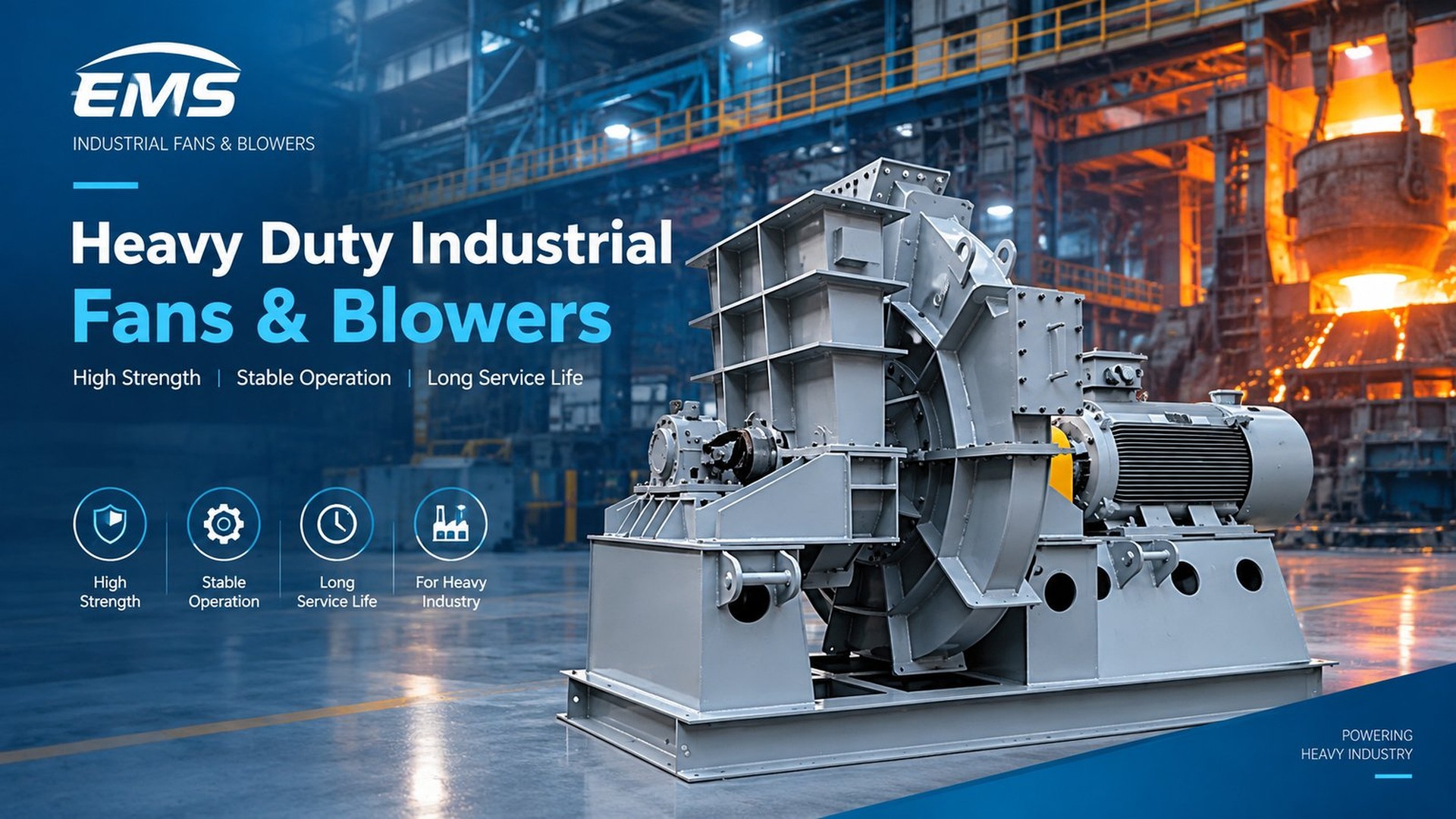


Process Ventilation Fan is applied in heavy industrial service to establish the required ventilation airflow for personnel, equipment and process safety in heavy industrial service. The handled medium is typically fresh air or mine/tunnel atmosphere. Selection starts from the required duty point and then checks required air quantity, resistance, installation distance and safety duty.
For this application, EMS reviews the complete system rather than treating the fan as an isolated component. Duct losses, equipment pressure drop, operating temperature, gas or dust characteristics, start-up conditions, control method and expected operating hours are considered before the fan, impeller, drive and motor configuration are confirmed.
工程说明:Process Ventilation Fan用于重工业工况相关工艺,核心作用是为地下或隧道空间建立所需通风量和气流组织。选型时应同时确认系统阻力、工作温度、介质特性、连续运行要求及现场安装条件,而不是仅按电机功率选择。
Establish the required ventilation airflow for personnel, equipment and process safety in heavy industrial service.
Fresh air or mine/tunnel atmosphere. Final material and sealing configuration depend on the actual medium.
Required air quantity, resistance, installation distance and safety duty.
Fan inlet/outlet orientation, control method and connection arrangement are matched to the duct and equipment layout.
| Parameter | What EMS Needs to Confirm | Why It Matters |
|---|---|---|
| Airflow | Normal / minimum / maximum flow, m³/h or CFM | Defines fan capacity and control range |
| Pressure | Static or total pressure at the duty point | Must cover real system resistance with suitable margin |
| Temperature | Normal and maximum operating temperature | Affects material, bearing, drive and thermal design |
| Medium | Fresh air or mine/tunnel atmosphere; include composition where relevant | Determines material compatibility, wear and sealing needs |
| Dust / Particles | Concentration, particle size and abrasiveness if present | Affects impeller geometry, wear protection and cleaning access |
| Motor & Power | Voltage, frequency, enclosure and site standard | Ensures electrical compatibility and adequate power reserve |
| Installation | Indoor/outdoor, altitude, space, duct direction | Determines base, orientation, accessories and service access |
| Control | Fixed speed, VFD, damper or process control signal | Defines operating range and energy-control strategy |
The engineering priority for this product is required air quantity, resistance, installation distance and safety duty. Where the duty includes temperature, dust, corrosion or hazardous-area requirements, EMS confirms the corresponding material, shaft/bearing arrangement, motor protection and accessories before quotation.
For replacement projects, the existing nameplate alone may not show the actual operating point. Supplying the old fan drawing, motor data, inlet/outlet dimensions, rotation, photos and known process conditions allows a more reliable replacement review.
Performance matched to airflow, pressure and operating point.
Configuration adapted to temperature, dust, corrosion and wear.
Send an existing model, nameplate, drawing, photo or performance data for review.
Technical data, drawings and project documentation can be prepared according to order requirements.
For a faster Process Ventilation Fan selection, send the application, required airflow and pressure, normal/maximum temperature, medium composition, dust or corrosion information, electrical standard, installation location and quantity. For replacements, add the existing model, nameplate, drawing and site photos.
Selection is based on the required operating point and the complete system resistance, then checked against temperature, medium and installation conditions.
Yes. Airflow, pressure, material, drive, motor, rotation, discharge direction and accessories can be configured to the confirmed project duty.
Yes. Existing drawings, nameplates, photos and performance data can be reviewed to define a replacement configuration and connection requirements.
Start with application, airflow, pressure, temperature, medium, voltage/frequency and quantity. Unknown items can be clarified during engineering review.
Compare related EMS fan solutions within the same process area and adjacent applications.
Share your operating conditions on our dedicated inquiry page. Our engineering team will review your application, performance requirements and configuration.
Request a Quote →